Catch Dungeness Crab
Learn how to catch dungeness crab, here. It's really fairly easy compared to catching fish and as basic as catching any other types of crab.
Crab-O-Licious.com will explain the in's and out's of catching these crustaceans and give you useful tips to help you be successful.
Crab Bait
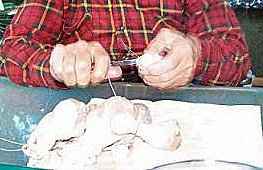
First things first. To catch dungeness, you need to use good bait. We use chicken legs or turkey legs. They are rather cheap and we have found that dungeness crab love turkey and chicken legs. If you plan on leaving the area where you throw your crab pots for longer than an hour and a half, we suggest using two legs per pot if using chicken or one turkey leg. That way all the bait won't get eaten before your pot gets full.
In order to have a successful day crabbing, your bait must be properly secured inside of your crab pot. The simplest way to catch dungeness crab is to be sure your bait is secured inside your crab pot.
To do this, take a piece of 14 or 16 gauge wire and cut it to about 4 inches
in length. Insert the wire through the chicken or turkey leg and wrap it back
around the bone and twist it to itself. Now you should have a chicken leg
attached to a piece of wire with a roughly 3 inch end to it.
Take this leg and wire, place it in the bottom-center of the crab pot with the wire end poking "out". Now wrap the remaining wire around the crab pots frame-work several times until secure. Your pot is now baited and ready to catch dungeness crab for dinner!
Another way to bait your pots is to purchase a bait pouch which you can fill with fresh chicken legs or left-over chicken meat and bones from dinner the night before. The bait pouch is fastened to the crab pot by means of a large "safety pin" that, when fastened correctly, not only holds the pouch in place but also keeps your bait in the pouch. Either way is fine and totally up to you. You can also use large plastic twist ties to secure your bait. Whatever is easiest and at your disposal!
Catch Dungeness Crab
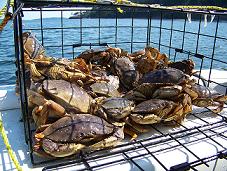
Now that your pots are baited you need to attach your line and harness to your pot. (Or you could have your line and harness already hooked up.) Once this is done and you are sure your bait is secure it is time to catch dungeness crab like never before.
Somethings to take into consideration:
- Where are you? .... Crab like somewhat sandy to rocky sea-beds paricularly that with some growth of eel-grass which affords the younger crab some sanctuary from their natural preditors.
- What time of day is it?... Generally speaking crab will move toward shore as the tide changes from low tide to high tide. Therefore, it becomes advantageous to know your tide tables in your area which tell you when low or high tides occur.
- How deep is the water?.... Dungeness crab have been found in waters up to 300 feet deep, but this is not practical for the sports crabber. We find that 55 to 85 feet depth works real well to catch dungeness crab. Bear in mind that when crabbing these depths you will need at least 100 feet of line. Please read our Crab-O-Licious crab tips up in the right hand column of this page.
The Big Catch
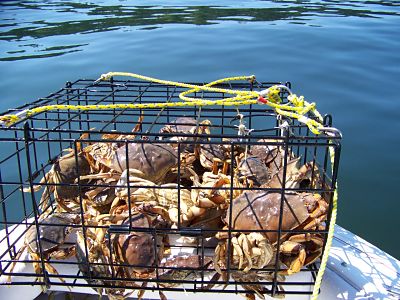
You found your "secret crab highway", the best place to catch dungeness crab, the depth is good and the tide is just starting to come in...THROW YOUR POT OVER BOARD! Once you have thrown all your pots over, (100 feet at least in between each one), go relax, perhaps, fish awhile. Let these crab pots "soak" for about an hour, two at the most.
If you leave your crab pots for more than a couple of hours, keep in mind those crab can strip your bait in less. You may want to consider a turkey leg if you leave for much longer than that.
Now comes the "fun" part!
Point your boat into the sea of floating crab buoys. (Hopefully you made a mental note of roughly where you dropped your pots!) Once in amongst the various buoys, search until you find yours, being careful not to disturb anyone else's equipment. Having located one of your pots, pull slowly up along side of it in order to grab it out of the water either by hand or by use of a gaffing hook (crab puller).
Immediately upon grabbing your buoy, turn the engine OFF on your boat. This will prevent the possibility of getting your line wrapped up in your propeller. (Not a pretty sight!)
Now then, pull! Coiling your line as it comes on board is essential to being able to quickly reset your crab pot again and coiling the line will help guard against getting the line all knotted up.
Crab Pot Alternative
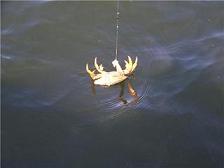
Another alternative way to catch dungeness crab is with a fishing line and hook! Oh ya! It's true! You don't necessarily need to use crab pots. If you know an area, perhaps by a dock by a marina or the like where crabs hang out, it's fairly easy to cut a chunk of chicken meat off of a chicken bone and put it on a fishing hook. Let your line down to the bottom of the marine water. Remember...crabs can't swim! They crawl the ocean floors, so you have to let crab bait sink to the bottom on your line. Next, simply bounce your line and bait on the bottom and wait for the gentle tug of the crab on your line! Once they are on the line, pull them up slowly and as soon as you see them coming up out of the water, gently lift them into a net for safe keeping!
The only downfall to catching dungeness crabs with line and hook is that you only get one crab at a time. However, this can be a big pro for people that are just seeking a meal at a time, like campers, or those with no freezers to store more crabs for later. It's also a fun way to teach children how to crab!
And then there's free diving for dungies....But we don't recommend it unless you are a certified diver...Cool video, though!...You notice in the video where he picks the first one up and let's it go that was because it was a female crab, which are off limits in the Puget Sound area.
Measuring and Dividing the Catch
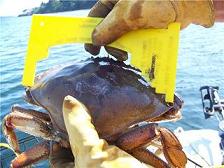
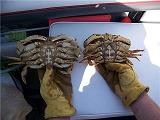
Once you have your crab pot pulled to the surface, pull it into the boat and begin to sort your (hopefully) large haul and measuring your catch. To do this, remove the crabs one at a time being sure to not get "bit" or "clawed", flip each crab upside down to see its belly to determine its sex. You do this by simply taking a measuring caliper and measuring the crabs shell across the widest area of the shell. Throw out ALL female (wide belly/the crab on the right in the picture) and juveniles (under 6 1/4 inches wide across the shell). Keep the male crabs (narrow belly/on the left in the picture).
Also, on a side note, you may have caught a legal limit sized or bigger crab, but you need to check him and see if he has fully molted back into his hard shell state. Roger will explain this in this video...
With that said, make sure you have a nice golden-toned-legged Dungeness and it's not white and soft. It may still need time to grow back into it's new shell. If you keep the softer shelled crabs, they won't have much meat to them. Why not throw it back and let it grow and grab another one that's good and meaty!?!
And They Shall Be Called
"Male and Female"
|
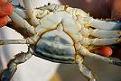 Female Crabs abdomen or tail is very wide and covers part of each basal leg segment. The embryos are wider under the tail on adults. |
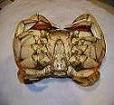 Male Crabs have triangular shaped tails which are only one third the size of females and much narrower. |
Measure each male across the widest part of the shell keeping only those that are 6 1/4 inches wide or larger.
Now, it's imperative to keeping crab alive. We'll tell you why and how.
Note that these techniques to catch dungeness crab is quite similar to how you catch any types of crab with the exception of soft shell crab. See Crab Tips over in the right hand column of this page for more tips on how to catch dungeness crab successfully.
Read about Dungeness Crab Season
Have fun!
"Catch 'em! Clean 'em! Cook 'em! Eat 'em!"
Look for some delicious crab recipes on Crab-O-Licious.com for all types of crab!
Go back up to the top of Catch Dungeness Crab
|
|


"A crab provides little food, so he is not so easy to eat. But the little food he does offer is the best food under the sky. To eat crab you must work, which makes you appreciate him more. He is the blessing, the remembrance. And no man or woman ever ate enough." — James A. Michener, Chesapeake
Catching Crab Tips:
Crabbing Tip #1:-When out crabbing in the waters, it's a good rule of thumb to have a depth finder (or fish finder). Why? So you can determine if you have enough rope in the area you are in to throw your crab pots.
For instance, if you have 50 feet of rope and throw the crab pot into 100 foot deep waters, you won't catch any crab. The pot will sink to the bottom and more than likely you will lose the pot and all your equipment.
You need to know the depth of where you are putting your crab pots, so you know that your pot will lay on the bottom of the ocean in the area you are crabbing. The crab pot needs to sit on the bottom, attached to the rope and the buoy needs to be floating and visible.
Many times we have seen crab pot buoys floating aimlessly through the waters just below the surface. This results to no crab being caught. The crab pot more than likely won't get found by original owner, and the floater pot could be a hazard to another boater if the rope gets tangled on a propeller of another boat.
Crabbing Tip #2:
Check with your local Fish and Wildlife Agencies for legal catch limits and legal sizes before going out and catching crab. May save you a ticket and/or loss of license. Also, check with them every year as sizes and legal limits may vary from year to year as well as crabbing season schedules.
Crabbing Tip #3:
Be creative and distinguish your buoy from the others. For instance, we at Crab-O-Licious use duct tape to write our names and addresses on duct tape and tape it to our buoys. It's a great way to change out names when one of our license's have limited for the day to another licensed crabber. And duct tape sticks to the buoys well. Just make sure it is changed out every season.
Other people use fancy knots at the top of the buoy with the rope to distinguish theirs. There are many other ways to make it visibly and un-mistakenly yours so you can find it easily.
Crabbing Tip #4:
Be kind. Be courteous. Always look on the buoy to make sure it is your crab pot before pulling it completely out of the water. Check the name and address to make sure. If it isn't, please throw it back.
Happy Crabbing!

New! Comments
Have your say, ask a question, or at least say hello! Leave us a comment in the box below.